A bill of exchange is a written document containing an order from one person (the drawer) to another party (the drawee) to pay a certain amount of money to a third party (the payee) at a specific time or upon presentation.
In the financial world, there are many ways to make payments or send money. One method that might seem old-fashioned but is still relevant today is the bill of exchange. Even though we live in a digital age, bills of exchange are still commonly used for official transactions, business dealings, and even for sending money to areas that lack access to modern banking services.
So, for those of you who aren't familiar or curious about what a bill of exchange is, its function, and how it works, let's dive into a detailed explanation below!
What is a Bill of Exchange?
Have you ever heard of the term bill of exchange? No, it's not about old love letters, but rather a legitimate and still widely used payment instrument!
A bill of exchange is a written document that contains an order from one person (the drawer) to another (the drawee) to pay a specified amount of money to a third party (the payee) at a specified time or upon presentation. Bills of exchange can be used for various transactions, including paying debts or transferring money internationally.
Types of Bills of Exchange
It turns out that bills of exchange come in several types, each with its own role and purpose. They are suitable for personal use, business transactions, and even international transactions. Let's break them down!
Also Read: What is Payment? Understanding the Types and Differences
1. Postal Money Orders (Wesel Pos)
Postal money orders are issued by postal services. They're often used for sending money to people, especially to areas that don't have access to banking services or digital platforms.
For example, if you work in a big city and want to send money to your parents in a remote area, you can use a postal money order. The recipient can go to the nearest post office to collect the money.
2. Bank Draft (Wesel Bank)
This type of bill of exchange is issued by banks and is typically used for large transactions, such as paying suppliers, purchasing imported goods, or conducting business transactions between companies.
Since it’s issued directly by a bank, this type of bill of exchange is considered more secure and has strong guarantees.
3. Domestic Bill of Exchange (Wesel Inland)
As the name suggests, this type is used for transactions within the same country. So, if you have business dealings between cities or regions within Indonesia, a domestic bill of exchange could be the right choice.
For instance, if you're selling goods in Jakarta and the buyer is in Surabaya, you can use a domestic bill of exchange as a valid payment method.
4. Foreign Bill of Exchange (Wesel Luar Negeri)
If your transactions are international or cross-border, this is the go-to choice. Foreign bills of exchange are commonly used in export-import trade or global business cooperation.
For example, if you're buying goods from a supplier in Japan, using a foreign bill of exchange can make the payment process safer and more professional.
5. At-Sight Bill of Exchange (Wesel Tunai)
This type is ideal for those who prefer convenience. The payment is made immediately upon the presentation of the bill. As soon as the bill is received and shown to the payer, the funds are disbursed right then and there.
6. Usance Bill of Exchange (Wesel Berdasarkan Tanggal Jatuh Tempo)
Unlike the at-sight bill, this type allows payment to be made at a specified time, for example, 30 days after the bill is issued. It's perfect for those who need time to manage cash flow or finances in business.
Functions of a Bill of Exchange
A bill of exchange is more than just a piece of paper. Despite its simple appearance, it has several important functions that remain relevant today! Here are some key functions:
- As a payment method for business transactions or personal needs.
- Used for sending money to areas not covered by digital or banking services.
- Acts as a formal written guarantee of payment in a contract or agreement.
- Facilitates international trade because it is globally recognized and trusted in cross-border transactions.
Also Read: Online Payment: Definition, How it Works, and Benefits
Example of a Bill of Exchange
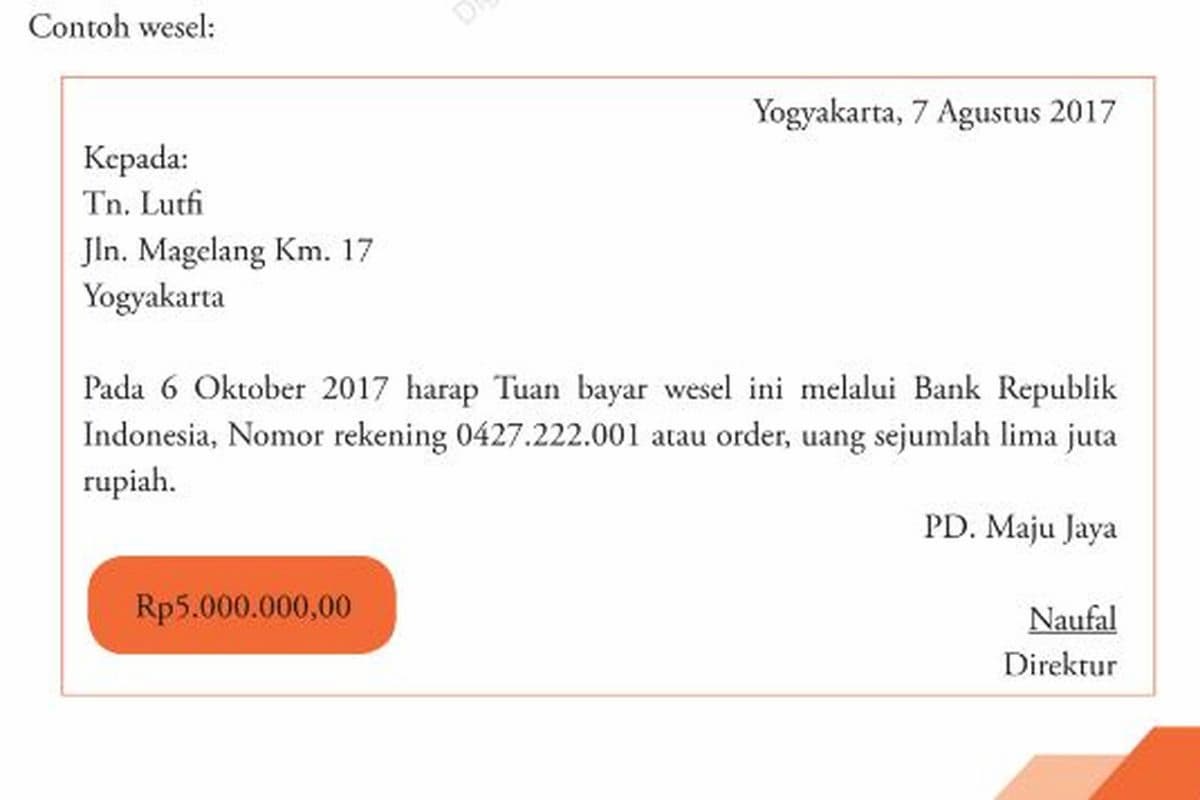
Imagine you want to buy goods from an overseas supplier. You can issue a bill of exchange that contains instructions to your bank to pay a specified amount to the supplier at a designated time. Here’s an example of what a bill of exchange might look like:
Conditions for Using a Bill of Exchange
You can’t just write it out and expect it to be valid. A bill of exchange must meet several conditions to be legitimate and usable:
- There must be an unconditional order to pay a certain amount of money.
- The name of the payee must be specified.
- The date and place of issuance must be indicated.
- The payment time (either immediately or on a specified date) must be mentioned.
- The drawer’s signature must be present.
- The amount to be paid must be clear.
If any of these conditions are not met, the bill may not be valid.
Differences Between a Bill of Exchange and a Check
Although they may seem similar, there are key differences between a bill of exchange and a check. Here are the main differences:
| Difference | Bill of Exchange | Check |
|---|---|---|
| Party Ordering Payment | Drawer (could be non-bank) | Drawer (bank customer) |
| Paying Party | Could be a bank or another party | Always a bank |
| Payment Time | Could be immediate or at a specified time | Always upon presentation |
| Used For | Short to medium-term business transactions | Withdrawal of funds from personal/business accounts |
| Certainty of Funds | Not always guaranteed | More guaranteed since it’s drawn from the drawer’s account |
I hope this article helps you better understand bills of exchange. Even though technology is advanced, payment methods like this still play a vital role, especially in business and international transactions.